
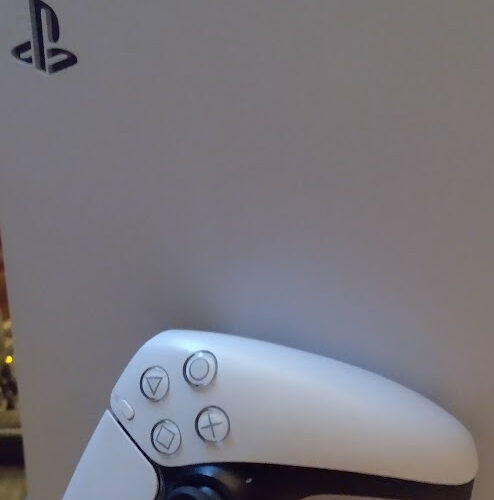
A PlayStation 5 is shown (photo curiosity of Patrick Eiland).
Since 2001 when I got my Gameboy Color and copies of Pokémon Yellow Version and Silver Version, gaming has been my go-to hobby to unwind and enjoy myself but this medium is teetering on the edge of falling apart and it’s upsetting me.
Back on July 1, Sony announced that they would discontinue physical disks for all games released on their consoles by the start of 2028 with the implication that the PlayStation 6 would not release with a disk drive version at all. The announcement shook the internet and put people up in arms, myself included. Why? The reasons are plentiful.
Let’s start with the big one. Unlike when you buy the physical disk, you don’t fully own digital downloaded versions of games. The proof of that can be found in an incident that took place just a few days before Sony’s announcement.
On June 26, an article by John Walker of Kotaku said that Sony released a notice saying movies bought on the PlayStation store that were distributed by StudioCanal would become inaccessible and removed from people’s video library.
“There’s no mention of any refunds or make-goods for the affected users.” Walker said. “Sony simply says the films are going away “due to our content licensing agreements,” once again reaffirming the fact that you are never truly buying anything that’s digital, just temporarily renting it.”
If it can happen to movies then it can surely happen to games and with most video games costing anywhere from $50-$80, just losing access with no refund is infuriating to think about.
So why is Sony doing this? Money. Wesley Yin-Poole’s recent article on IGN brings up some interesting numbers:
“For a first-party PlayStation game such as The Last of Us, Sony will only keep around 65% of the money from a physical copy, with around 30% going to the retailer and roughly another 5% on manufacturing costs. Meanwhile, for a physical copy of a third-party game such as the Activision-published Call of Duty, Sony will get a licensing fee, likely around 15%.”
While those same sales through digital would net Sony 100% of profits from first party and 30% for third-party games. This shows the value of owning physical media. Books, disks or cartridges if you have in your hands, you own it. Sony can’t kick your door down and take the disks off your shelf, but they can delete them off your console.
Now let’s say this doesn’t bother you as much as someone who buys games digitally anyway, well gaming has bigger issues than just this.
Back on March 26 Sony released a notice stating the PS5 would undergo a price hike with the base PS5 going to $650. I got mine in January of 2021 for $400. So why raise prices and by so much? You can point to the AI boom.
In an CNET article by Omar Gallaga, he says, “One reason analysts believe motherboards are likely to go up in price is that practically all electronic components are being affected by the AI data boom, with data centers gobbling up memory and storage products, creating supply constraints.”
This isn’t strictly an issue with gaming consoles, but with everything that needs computer parts. If you know how supply and demand works then all the pieces fall into place.
So, if I did change my tune and say I wanted a PS6 anyway, not only would I not be able to get one that reads disks but that it would also cost me at least an arm and a leg to buy one according to information, as reported by Tom Henderson of Insider Gaming.
Henderson said that with the current price of parts each PS6 would cost about $960 to make and if Sony wants to make a profit, it’ll have to be well over $1000. This is just for the PS6. The Xbox Series X and Nintendo Switch 2 have had price increases lately and their next consoles will have to deal with the same issues.
All of this has me sitting here feeling sad that a hobby that’s been so interwoven into my life, a hobby that’s let me enjoy characters, worlds, stories that have shaped me as a person is falling apart because of corporate greed and the AI boom causing more issues every second.
I don’t know what the gaming industry will look like in 3 years and at this point, I’m too afraid to ask.