

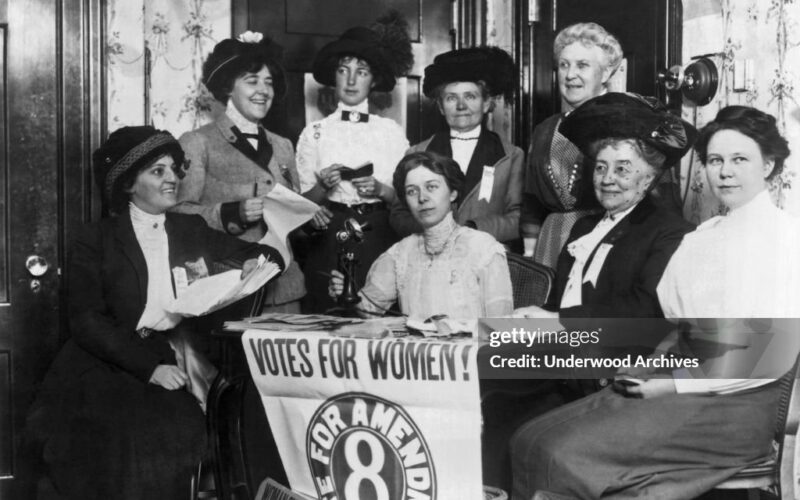
A group of women fight for the first voting rights in the 1920s’. (Credit to Getty Images)
By MacKenzie Holland
In the 1910s, women fought to have a voice in American democracy, with Congress passing in 1919. More than 106 years later, some women are choosing to let someone else speak for them.
The term “tradwife” is a common phrase used on social media to describe certain women who choose to live a traditional domestic life, submitting to their husbands. The movement has also attracted academic attention for its relationship with feminism and traditional gender roles. In a 2025 study “The Anti (Feminism) of Tradwives” published in Terrorism and Political Violence by Rebecca Stotzer and Ashley Nelson, researchers surveyed 61 TikTok users, examining the relationship between tradwife philosophies and anti-feminist beliefs.
These women associated with far-right politics seem to choose to live this lifestyle, while women born in the 1900s did not have a choice with even the right to vote being a far distant dream. Fast forward to 2026, tradwives are deciding to stop voting with the reasoning being their husband’s votes are the only ones that matter. TikTok creator Hannah Neeleman, widely known as the creator of Ballerina farm, is the global “face” of the movement.
No matter who you vote for or even why, exercising the 19th Amendment shows that we as women are no longer forced to be legally bound to our husbands and finally treated as individual citizens.
Within recent years, it feels almost acceptable for women to fall back into this life that so many women used to call a prison, some women choosing to not research anything to do with politics and claiming they are “just not interested” women like Susan B. Anthony who played a huge part in the women suffrage movement deserve better. This, which may be a joke to women nowadays, was a life or death situation for some.
These women have never fought to be heard so they feel safe and comfortable in their silence. The silence of being okay with losing your individuality, while many women in other countries like Afghanistan are not allowed to even speak. Are begging and screaming just to be heard, while the women in the United States fail to exercise a right that is not universally guaranteed.
A study by Center for Information and Research on Civic Learning and Engagement (CIRCLE) on youth voter turnout showed that the percentage of young women voting from the ages 18-29 dropped from 55% to 50% in 2024. While this 5% point drop may seem small, it raises a larger question – Why are younger women less interested in the political process, especially after we fought so hard for the opportunity to participate?
In the past five years a spike of tradewives on social media has appeared, with many popular creators being the face of this anti-feminist movement rejecting their tradwife label. An April 2026 study by Psychology of Women Quarterly written by Veronica Hopner and Sophia Sykes delves into “de-tradding” which includes women who reject the label trad-life and its counterpart of rejecting the trad-life lifestyle.
While not every tradwife chooses not to vote, the push of submitting to your husband gets lost in translation and many young women misinterpret this behavior and build uneducated opinions based on what they see on social media. So to ask the question, are these movements influencing younger generations on their independence and uneducating them, on topics that influence how they live.
Younger women need to think and speak for themselves, rather than allowing their-selves and other women to stay silent. Now over 100 years later, women are not facing the problem of being allowed to vote but the problem of wanting to vote.
So today I ask you to vote, for yourself, for those who can’t, for your daughters and for a better future.