

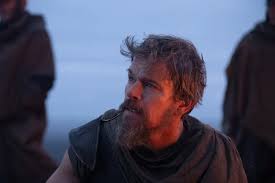
Review: From Homer to Dante, ‘The Odyssey’ is now Christopher Nolan’s magnum opus
“A face, a fleet, a war, a man, a thought, a trick. A trick to break the walls of Troy and burn it screaming to the ground!”
These opening words ignite of the most ambitious movie adaptations of the 21st century. This year’s “The Odyssey”, as Christopher Nolan explained to Eliana Dockterman for Time, breathes new life into a version of the hero Odysseus, preserving his Homeric complexity while making him relatable to a modern audience.
Nolan’s adaptation of Homer’s classic Greek epic poem has been advertised with promises of greatness, and expectations did not disappoint. From the very opening, the director’s ability to transport a 2,700-year-old work in a modern movie is clear: the Oscar-winning filmmaker is capable of captivating millions of moviegoers around the world for almost three solid hours. Purist classicists, perhaps, might be disappointed, and fidelity to Homer’s work is not slavish. But it is perhaps precisely this new angle portraying Odysseus dealing with human problems, such as dealing with his pride, that makes “The Odyssey” so satisfying.
The numbers are staggering, and the opening weekend boom lived up to expectations. According to Jake Coyle of the Associated Press, the movie debuted globally with box office receipts of $264.1 million. The film broke box office records, even surpassing the debut of “Oppenheimer” and marking the director’s best opening since 2012, when “The Dark Knight Rises” was released.
Long ahead of its premiere, “The Odyssey” had already established itself as one of the most anticipated movie of 2026. Even before the first spoilers, the stellar cast — Matt Damon as Odysseus, Anne Hathaway as Penelope, Tom Holland as Telemachus, Zendaya as Athena, and Charlize Theron as Circe — had already raised the bar of expectations that turned out to be largely exceeded. The project turned out to be pioneer in cinematography. For the first time in the history of cinema, according to the Time, the movie was shot entirely in IMAX 70mm. A technique never used before, except for short scenes and never for dialogues.
The film shots proved difficult and extreme, said Emma Thomas, Nolan’s wife and film producer in a July 17 Guardian article. “Almost everyone describes it as the hardest shoot of their career – like making seven ambitious movies in one,” Thomas said during an interview with The Guardian’s Tom Shone. The scenes, shot in Italy, Morocco, Greece, Iceland, Scotland and Malta, saw cinematographer Hoyte Van Hoytema’s team dragging the 300-pound camera day by day, often in precarious conditions. The high weight due to the soundproof containment shell of the IMAX which made it possible to suppress the deafening noise that would have covered every conversation, Thomas added.
“Tell me, O muse, of that ingenious hero who travelled far and wide after he had sacked the famous town of Troy,” are the first words of the great Greek poet Homer. But they are not the same as Christopher Nolan, who tells the story of the man who, now wandering, finds himself coming to terms with the past and with what his cunningness has achieved for himself. Nolan told Shone from The Guardian, that he was attached to the script and almost directed the 2004 historical action film and blockbuster “Troy.” (which was directed by Wolfgang Petersen). From that moment, the desire to cinematically transport a Homeric work has never abandoned him.
It was precisely this faded opportunity that led Nolan to imagine for almost twenty years how he could materialize the glorious Greek epic in images. As he shared with Shone, “Had I spent a lot of time figuring out how to present this to an audience that everyone knows that that horse’s belly is full of Greeks? How do you make it believable?”
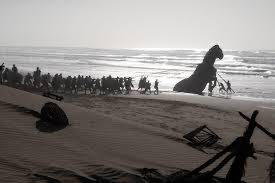
Credibility came with the brilliant vision of a colossus, presumably the horse immersed in the sand, which made its eyes shine and take your breath away from this first visual moment. Nolan defined it as “A true Hail Mary, as we say in America, just an act of absolute desperation that shouldn’t work. That was the first image I had. I carried that with me for 20 years. I always wanted to do it.”
In addition to his masterful interpretations and scripting, Nolan was also able to draw parallels from such an ancient work to modern times. To find those values and those constants also present in our society, and to distort as in the case of Odysseus (Matt Damon-mention him and other leads earlier), making the hero a simple man imprisoned by the war that he himself has won. A parallel can indeed be seen in his state of sufferance, known as moral injury which is often seen in war veterans, torn between who they were before the war and who they are now.
Throughout history, many poets and thinkers have sought to put a face to the great Greek hero. For the first narrator, this was about a great leader with the divine virtue of cunningness and ingenuity. For Dante Alighieri, in his greatest work “Inferno, Canto XXVI” he relegated Ulysses (Odysseus) to the eighth pouch of hell, where he was unable to find forgiveness, due to the conflict between the character and the divine will. Therefore Ulysses did not achieve the first objective of the medieval era, which was divine absolution, as explained on leonardofrigo.com. It took 700 years for another visionary (Nolan) to look at the Greek king from a different perspective, giving him earthly, almost fragile nuances. Nolan does not condemn Odysseus, but neither does he absolve him, allowing him to come to terms with his deepest human self.
The director shifts the center of gravity of the story: the fulcrum is no longer the journey back to Ithaca, Odysseus’s homeland. The cornerstone of the story was an unexpected element that ultimately ended the war: the horse. What turned Odysseus into the most astute general and the great hero of the Trojan War becomes to all intents and purposes, his trauma — the origin of all his guilt.
If Homer saw cunningness as his highest quality, Nolan gives it a completely different nuance. The deception of the horse remains undisputedly the most astute and successful plan of the epic story. But genius is no longer just a virtue. On the contrary, it is flanked by a sense of guilt. Two arrows are shot from the same bow. “His cunning is entwined with his crime,” said Professor of Psychological Sciences Amy S. Badura-Brack in an article in The Conversation. Badura-Brack said that Odysseus becomes a war hero marked by the horrors he has witnessed, and Athena played by Zendaya can almost be understood as a psychological projection of the hero himself.
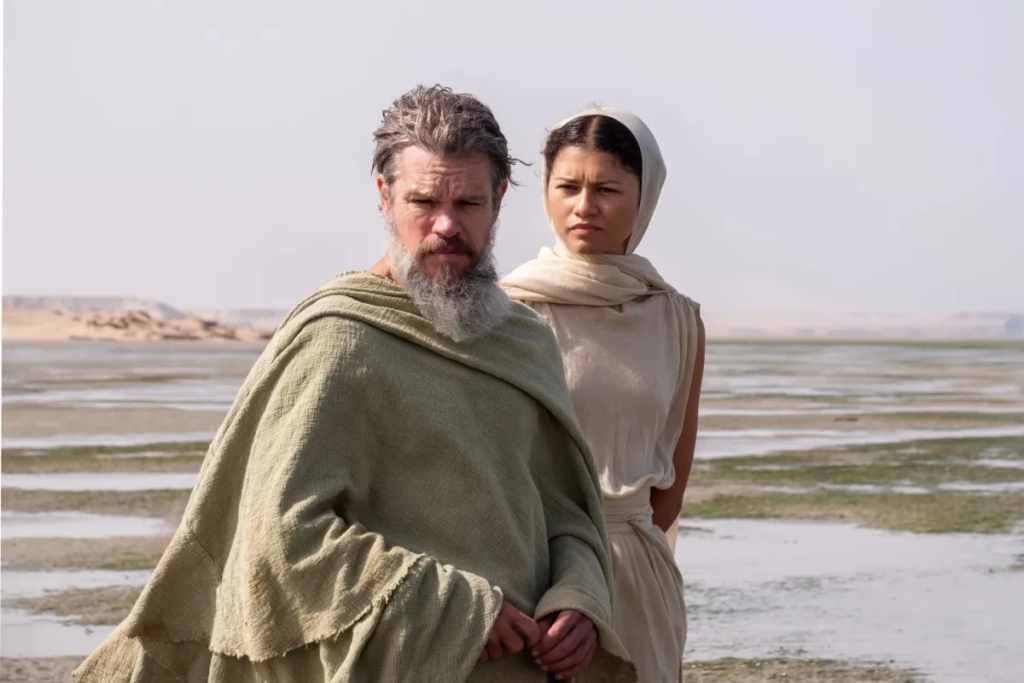
It is Zendaya in her role as goddess and protector of Odysseus, who is the turning point despite a small presence on the screen. Athena is the only deity actually incarnated within the film, but only at the end is it understood that she too is only a projection of Odysseus’ faults. She is there in moments of difficulty, when the hero insists on challenging the divine, and she is there when he finally makes the leap of faith, renouncing control, at the mercy of the waves. Athena changes clothes, she was never the protective goddess of the warrior, but she was the part of the man who had never accepted, and who prevented him from returning to Ithaca.
Odysseus returns to his land only when he decides to give up fighting against destiny, it is the renunciation of the control he has always had and that has marked him, that leads him on the road back.
And here comes the paradox. Homer makes him go to meet his destiny but then accompanies him on his return home, Dante Alighieri does not forgive him. The divine supremacy that descends from the other judges the work of man. But on the contrary, Christopher Nolan comes to the conclusion that in Odysseus judgment rises from within, it is the man himself who is his own judge. And this is how Nolan leaves the hero, the man, Ulysses, the vigilant nightmare of man who realizes that heroism does not exist.