

A pink bow, symbol of Brest cancer awareness month on a board with the world “survived” (photo by Pexels)
It’s 2005. A woman sits in a waiting room, nervously tapping her foot, unaware that she’ll walk out of that building with five letters printed on a piece of paper: cancer. She’s 38 years old and has a two-year-old daughter.
To protect her privacy, we’ll call her Emilie.
Her world suddenly came crashing down. “I was always chasing the future,” says Emilie. Along with this news went away her dreams, especially that of having another child. “Having to give up on having another child was the greatest pain of my life.”
But Emilie is just one of the four million women who, according to reports from the American Cancer Society, have beaten breast cancer and are living with it after a diagnosis. Breast cancer is the most common malignant tumor among women in the country. Despite this significant statistic, the United States is the leading country in the treatment of this cancer, with a 5-year survival rate of 91.9%, compared to 81.8% in Europe, as reported by the National Cancer Institute.
She was only 38 years old when her body first spoke to her in a language no woman would ever want to understand. Emilie always says, “Follow your instincts,” and that’s exactly what she did. The first step was a diagnostic test, which one doctor said came back completely normal. But trusting the instinct that had always guided her, she decided not to rely on that initial diagnosis. “I didn’t believe it, because deep down I felt that I actually had a feeling that I shouldn’t stop, that I had to see it through,” Emilie said. Before long, she would learn that language very well.
Her determination and clarity of mind led her, on the very day of her diagnosis, to seek out an oncology specialist, waiting for hours in a sterile hospital hallway. “I went to the hospital and waited for hours for the oncologist to arrive, entrusting my very life to her,” Emilie said.
Discovering cancer forced her to slow down and reflect on life and choices. Whereas she had once believed herself invincible and capable of anything, she was confronted with the transience of life and its fragility, like a leaf on a tree in autumn. The psychological aspect is a silent shadow throughout the illness, the most difficult moment, as Emilie describes, is the realization of the loss of a part of her femininity. “I was suddenly struck by the realization that I was more fragile than I had believed.” said Emilie.
Despite the uphill battle of the illness, the most painful and difficult moment to process is undoubtedly the end of treatment. “It’s a paradox, but the end of treatment gave me a sense of abandonment, whereas before I was constantly monitored, check-ups were then reduced to twice a year,” said Emilie. Furthermore, an unexpected aspect is the gratitude that turns into love for those who saved her life. “With the doctors, it’s almost like falling in love, they are the ones in whose hands you trustingly place your life.”
Those who have beaten cancer say that a key part of recovery is having a driving force, a reason to fight. For Emilie, in addition to her simple love of life, that driving force was just over three feet tall, with curly hair and a mischievous look in her eyes, her daughter.
Science explains and confirms the bond between children and parents who are going through an illness like cancer. A 2023 study conducted by Curtin University and published on Children analyzed how children with parents diagnosed with cancer may experience high levels of anxiety and worry, yet they serve as a concrete reason for their parents to fight the disease. “My daughter has always been my primary driving force,” said Emilie. “Besides, it was too soon to give up on life.”
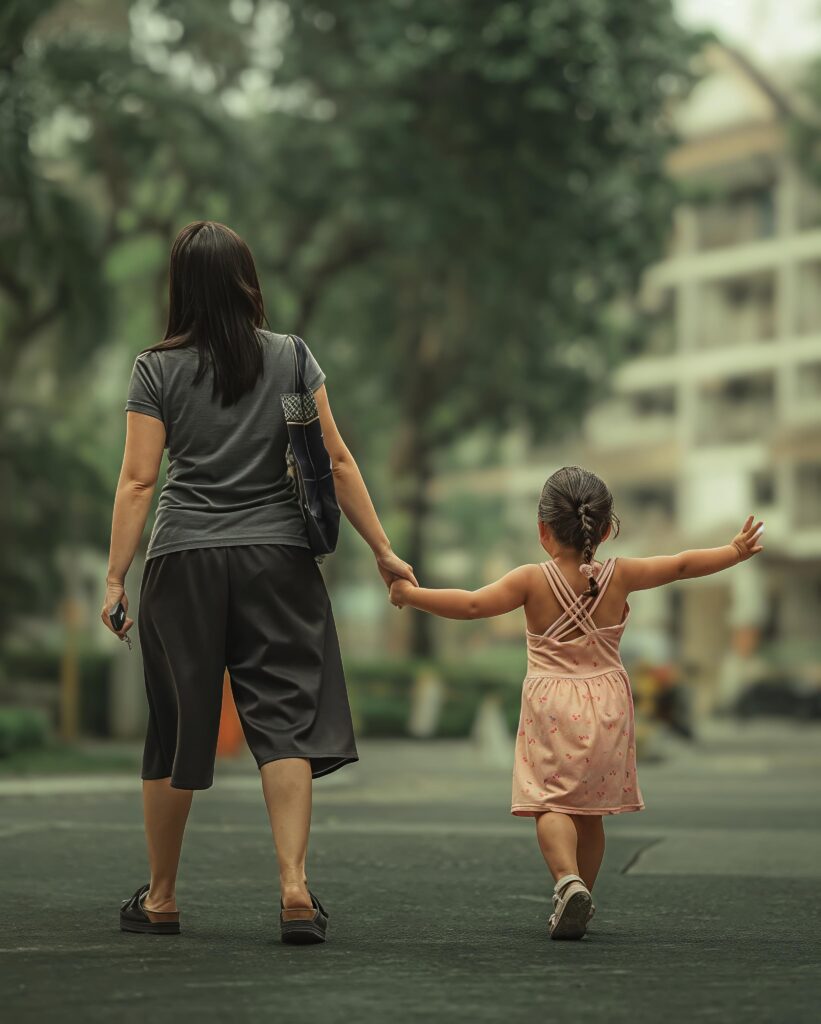
Emilie has always put her family first, a young daughter and a husband who was going through one of the most important moments of his career. The news of her illness hit like a storm, but with strength and determination, she managed to keep the family afloat. “I think my husband is more fragile than I am; for him, it was a major blow,” says Emilie. “He was paralyzed by fear, but we had to keep going, it was the only possible cure for us.” She recalls how he was about to give up on a professional event that would have officially welcomed him into the big leagues, but Emilie was ready to support him and encourage him: “Go ahead, we’ll make it through this. I’m fine, it’ll all pass.” Because Emilie isn’t just a woman, a mother, a wife, or a survivor, she has always been the backbone, the silent pillar supporting her family’s successes.
Overcoming her illness has led Emilie to new insights, helping her see life and her daily routine from a different perspective. She has reached a new level of maturity, realizing the futility of many situations. “I’ve shed everything that might have weighed me down before,” says Emilie. Even a simple sunset has become a moment to savor intensely, as she has rediscovered the beauty of simplicity, and especially of life itself. You don’t realize how much beauty there is in things until you risk losing them. Another aspect that has changed her is her fatalism, something she didn’t know as a young woman out to conquer the world, as she has gained a new awareness of life itself.
Emilie reflects on the 20 years since her diagnosis, watching her life flash before her eyes, the difficult moments, the happy ones, and the carefree ones. She also offers a message to those who are going through what she experienced in the past. “To women who are battling breast cancer, I’d like to say, live it,” says Emilie. “Embrace the moments of pain within yourselves, but when you’re feeling well, go out, live, laugh, face life and fight for it with optimism.” Positivity is part of the cure itself. As several studies, including one by the American Cancer Society, have shown, a positive approach can lead to a better quality of life.
Months later, a mature woman is sitting in a waiting room with a little girl beside her. The same girl who, with her little pink glasses always slipping down her nose, was always ready to listen to a story or bury her nose in a book. The grandmother’s voice is soft and seasoned, and the story of Bambi flows from her lips. That same bright and sensitive little girl, despite being only two and a half, read between the lines far more than one might expect. “You were only two, but you were a bright and very sensitive little girl,” Emilie said. “Capable of grasping things probably far beyond your age.” That same story, which has made entire generations of children cry, was specifically designed to have a happy ending. But the little girl who saw beyond the story turned to the woman and said, “My mom will heal too.”