

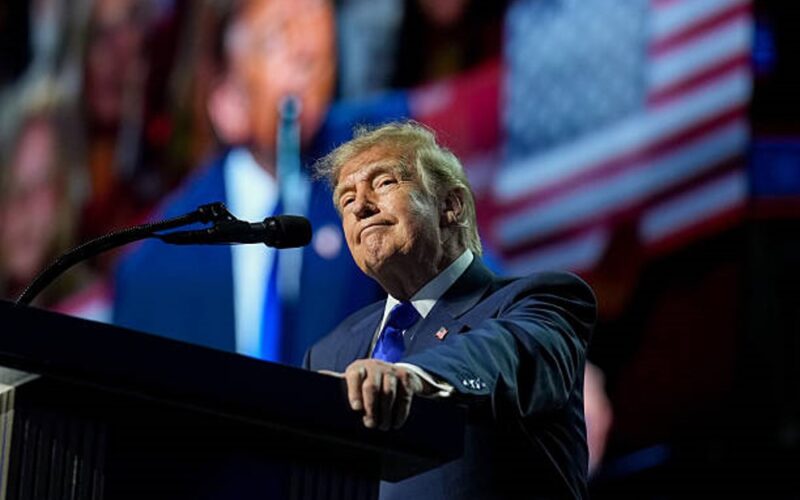
A picture of President Donald J. Trump standing and smiling behind a podium at the Republican Midterm Convention is shown. (Credit: Gettyimages)
To those who are keeping an eye on the current political scene, you may be aware of the Republican convention held in Dallas, Texas on Sept. 9 and 10, where several prominent party figures spoke about issues on the GOP party’s agenda.
The highlight of that event and what has caused a great deal of discourse within many other political circles was when President Donald Trump promised $5,000 to every American adult if the Republicans maintain control of the Senate and the House of Representatives after the midterms in November.
Many critics of this promise have gone so far as to call the promise a bribe, including Lisa Gilbert, the co-president of the consumer advocacy group, Public Citizen, who stated that, “This explicit and desperate attempt to buy votes in the November election is a new low. Trump knows he can’t do this, and yet he’s attempting to bribe voters with the false promise of cash to help his party win an election, which is antithetical to every principle of American democracy.”
Legal experts weighing in on the issue have come up with mixed results as to the legality of the promise, with some saying that these promises are merely equivalent to a campaign promise.
Assuming that the Republicans do secure congress after the midterms and that the courts find this promise to be legal, what does that mean for our readers – the students of AUM?

Computer science senior and former SGA president, Samuel Alford told the AUMnibus that if he received the $5,000 payout that it would help him transition from student life into his working life, saying, “I would take half of that and put it towards student loans. The other would go towards bills and house hunting for an apartment.”
Communication senior Haleigh Bedwell also spoke on what she would do with the money. “If I woke up and there was $5,000 in my bank account, I would trade in my car [which is] breaking down as we speak… It wouldn’t even cure half of my problems, but that is what I would do,” Bedwell said.
While it would clearly help out some of the students on campus, what might this mean for the country as a whole?
Firstly, it would be the largest stimulus payment to citizens in recent history, being almost twice as much as the combined $3,200 from all three COVID stimulus payments in 2020-2021.
Additionally, given that there are roughly 245 million U.S. adults, the total cost of this would be approximately $1.2 trillion. That equates to about 17% of the 2025 national federal budget and would nearly double the annual national deficit, bringing the annual deficit to roughly $3.0 trillion.
Commerce Secretary Howard Lutnick spoke on this matter in an interview with NBC News, saying that the administration would fund the payout, not from tax money or by increasing the national deficit, but instead by programs such as the Trump Platinum Card, though some still remain skeptical as to whether these programs would actually generate enough revenue to cover the 13-digit price tag.
Concerns around the promise are further stoked when looking back at other stimulus payments that Trump has promised before.

In February, Trump and Elon Musk, former head of the Department of Government Efficiency, endorsed a plan to directly give citizens checks based on the spending cuts from the department. That plan never came to fruition.
Trump also promised “A dividend of at least $2000 a person (not including high income people!) will be paid to everyone,” back in November 2025. The money from that promise has also yet to hit Americans’ bank accounts.
All this is to say that, even disregarding the cost this would take on the US government, this pledged payout may simply not happen, even if Republicans keep a hold of Congress.
And so we come to the ultimate question of this article, what happens if the Republicans keep control of both the House and Senate this year? There are two outcomes.
Outcome one is that this is a false promise being used to garner more votes so that a historically unpopular presidency can maintain some semblance of control in the legislative branch.
The second option is that the president actually does pay $5,000 to every adult in the country, which, while it would undoubtedly be helpful to many Americans, is a plan that still has some major concerns looming around it.
If it can actually be done simply through the income generated by new government programs, that would be great, but if it can’t and it has to be funded by further increasing the debt, then Trump and the Republicans will likely have a lot to answer for.