
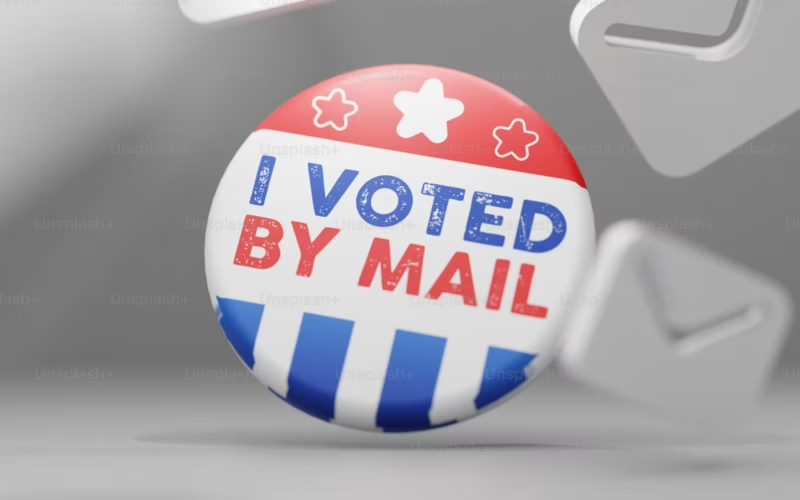
“I voted by mail” pin. (credit to unsplash.com)
Staff writer and political science and communication senior Tre Redden takes a deep dive into the current state of mail-in voting
(Sept. 7, 2026) – With midterm elections right around the corner, voters are likely to see important changes this fall on how to vote by mail, and it is possible that many may never even get their ballots, as the Trump administration continues its attempts to take control over elections.
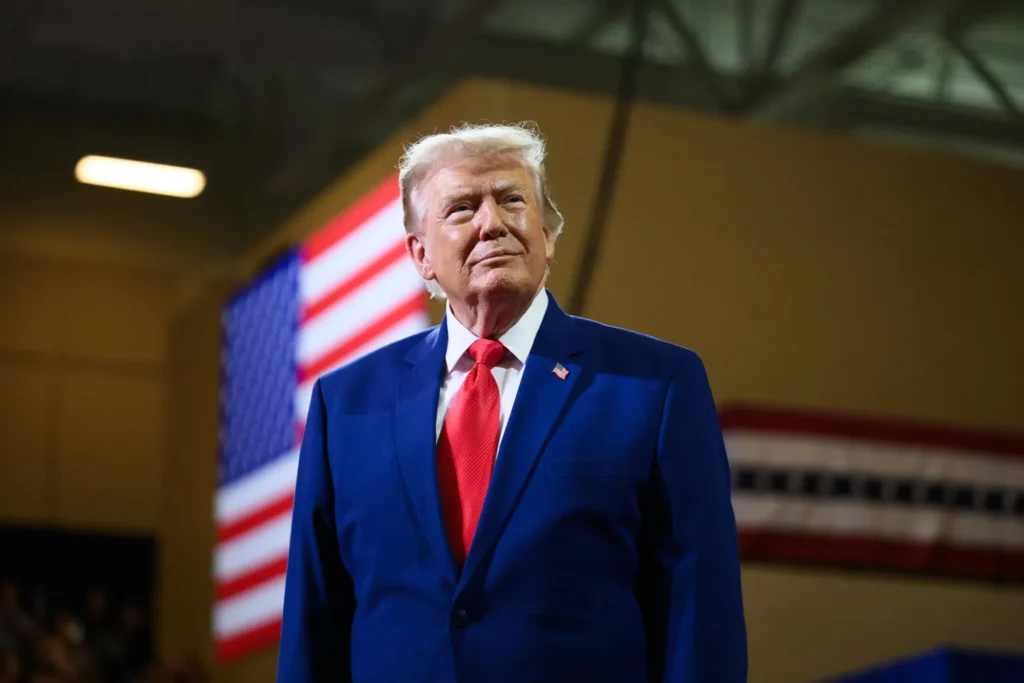
Those keeping up with recent politics may be aware that mail-in voting has become something of a hot-button issue as of late, with the practice most recently coming under attack via an executive order from U.S. President Donald Trump signed on March 31.
The order in question, Executive Order 14399, entitled “Ensuring Citizenship Verification And Integrity In Federal Elections”, turned more than a few heads when it was signed March 31 due to its fairly blatant attempt to allow the executive branch to start exercising power over mail-in voting in federal elections.
This is not the Trump administration’s first shot at voting rights, as seen with his strong backing of the 2025 SAVE America Act and the attempted implementation of Executive Order 14248, which would have given the federal government power over how states run elections, something expressly forbidden by Article 1, Section 4 of the U.S. Constitution.
Since the signing, we have seen an assortment of judicial actions on the matter, complicating the subject for the average voter, so today we’re taking a look into the current state of mail-in voting to see what you need to do in order to vote this November.
For some context on the practice, the earliest recorded instances of mail-in voting in the U.S. occurred in Pennsylvania in 1812, and in New Jersey in 1815. Between 1861 and 1864, absentee voting had become more widespread, as both many Union and Confederate states implemented absentee voting processes for soldiers, according to a 2024 article ”A History of Voting by Mail” by The Smithsonian Institute.
According to a June 24 MIT review on the subject, while certain states would begin to pass legislation allowing for exceptions to in-person voting, it wouldn’t be until the 1980s that mail-in voting would become a viable practice, as California passed the first law enabling voters to request an absentee ballot for any reason.
By this year, 28 states will have created laws allowing for no-excuse absentee ballots, and eight states and the District of Columbia simply mail ballots to all eligible voters without needing to request one.
President Trump has long criticized mail in voting, with one 2020 Politico article by Lara Seligman reporting on the 2020 presidential debates, where he was casting doubt on the practice even then. Trump reportedly said that ballots have been found in wastepaper baskets. “There is fraud; they found them in creeks, they found them with the name Trump in a wastepaper basket,” the president said six years ago. “This will be a fraud like you have never seen.” as quoted in the 2020 Politico report.
Trump’s attacks on mail-in voting have been proven to be false, or at the very least, blown incredibly out of proportion, as a 2025 study from the Brookings Institute suggests that for every 2.5 million mail ballots votes, one is fraudulent, or roughly 0.000043% of mail-in votes. The report made by Samara Angel, Jonathan Katz and Randi Wright claims the president’s stance on mail voting has fluctuated. “He has often criticized “100% Mail-In Voting” while at times signaling his support for absentee voting.”
Now with the history of mail-in voting out of the way, we may now focus on what has been happening as of late, regarding the president’s attack on mail-in voting.
As stated previously, on March 31, the president signed Executive Order 14399, the stated purpose of which is to “enhance election integrity via the United States Mail.”
The order instructs the Department of Homeland Security (DHS) and the Social Security Administration (SSA) to make a list for each state of the U.S. citizens there that are eligible to vote, and it also instructs the U.S. Postal Service (USPS) to only send absentee ballots to approved voters on those lists and to provide unique tracking barcodes for those ballots.
The order also authorizes the Attorney General to take steps to ensure states comply with these regulations, calling out withholding of federal funding as one particular means of enforcement.
Only two days after the order was signed, more than 20 states, the District of Columbia and several civil rights groups all brought forth suits against the order, citing executive overreach, according to an April 9 KSUA 9 News interview with legal experts on the subject.
Trump signs executive order targeting mail-in voting system
It took until June 25 for a judge to issue an official injunction, in this case U.S. District Court Judge for the District of Massachusetts, Judge Indira Talwani, according to AP News report last updated June 25 by Michael Casey, Bill Barrow and John Hanna.
In that case, two separate lawsuits were filed against the order on the grounds of unconstitutionality due to voting being a matter clearly and solely left to the states in Article 1, Section 4 of the constitution.
Judge Talwani agreed with the plaintiffs, issuing a formal injunction and saying that the order “unconstitutionally violated the separation of powers” and that it was “legally void.”
After going through several other courts, who each upheld the injunction, the mail-in voting case reached the Supreme Court, that, on Aug. 24, ruled 6-3 in favor of the Trump administration and lifted the injunction, with the three Democratic justices dissenting.
While, given the pace of the situation, one would be forgiven for thinking that this Supreme Court ruling is where things currently stand, that would be a mistaken assumption, as only three days later, the same court and same judge who issued the first injunction against the order issued another pause on the order on behalf of a different set of defendants and on different grounds, reported by the Legal Defense Fund’s (LDF) Aug. 27 report. The temporary restraining order will remain in place for 14 days while each political party briefs the pending motion for a preliminary injunction, as stated in LDF.
While this is happening, a whistleblower report released by Senator Richard Blumenthal’s (D-Conn.) Sept. 1 revealed that the USPS had been working to comply with Trump’s executive order since late July about mail-in votes, over a month after the injunction was put into effect, and nearly a month before it would finally be lifted.
Allegations on Aug. 31 made by The U.S. Senate Committee on Homeland Security and Governmental Affairs also say that the system that USPS was trying to develop and implement in time for the midterm elections was “secretive, rushed, chaotic and fundamentally flawed,” and that, “As [the system is] presently designed, if even one bar code on one single ballot in a bulk-mailing of 10,000 ballots fails to properly scan during the verification process, the entire batch is rejected and sent back to the state – effectively stopping the ballots from being mailed to voters.”
This means that even if the executive order were to be free from court injunctions, restraining orders and the like, it is highly likely that USPS would either not be able to implement the system in time for the midterm elections or, in a more chilling possibility, that the flawed and buggy system would be implemented, resulting in major disruptions to countless voters ability to cast their ballots.
This leads us to discuss the local impacts of this mail-in ballot situation, which is where things become slightly more nuanced.
As Alabama is one of only 13 states who still require a submitted and valid excuse in order to receive an absentee ballot, this will not directly affect most voters in the state, though residents who need absentee ballots due to military service, severe illness or any other sufficient reason could still be impacted by this new voting system by Trump.
Where this begins to affect the average Alabamian more is when this is taken at a broader scale.
Firstly, this still affects the ability of voters to cast their ballots in 37 states and the District of Columbia, which could have major ramifications for Congress, as a whole. This does end up impacting Alabamians, as Congress passes national laws, declares wars, enters into and removes the U.S. from formal treaties and more.
Secondly, as was mentioned at the beginning of this article, this is not the Trump administration’s first attempt to expand the federal government’s control over voting.
If this executive order succeeds, it is likely that the administration would be emboldened to attempt to assert more control over elections in the 2028 general elections. This is a possibility that, if proven true, would not only be unconstitutional, but also deeply and fundamentally undemocratic and un-American.
Given the current pace of this ever-evolving situation and the fact that there are still two months until Election Day, we are likely to see many developments between now and Nov. 3.
Times like these of mail-in voter uncertainty could inspire fear over the future of the country and the blatant federal overreach we see today, but we are witnessing in real time how the systems in place – particularly the courts – fight back against situations like this in order to protect our rights.
While things may seem grim for the future of mail-in voting, one must remember that the torch of freedom shines brightest in the dark. And we the people work every day to keep that flame alight.