
By: Seth Murdick
MONTGOMERY, Ala. — Award-winning WSFA 12 News meteorologist Amanda Curran sat down for an interview on Sept. 18 inside WSFA 12’s station to discuss her time as a weather forecaster, including the challenges of working in an extreme weather-prone state like Alabama and changes within the world of meteorology, such as artificial intelligence and how it could affect broadcast meteorology.
Before Curran made Alabama her second home and joined WSFA over a decade ago in 2014, she grew up in the northeast area of Litchfield, New Hampshire. Later, she invested four years in Vermont where she earned her bachelor’s degree in Atmospheric Sciences and her associate’s degree in Electronic Journalism Arts at Northern Vermont University, formerly known as Lyndon State College. Curran notes that it wasn’t difficult to decide a career path. “There was never a time where I couldn’t remember not loving weather,” Curran said. “Everybody usually has some kind of origin story, there’s a big storm, something impactful, trying to gain knowledge because maybe they were scared — mine was just… Clouds are so cool,” she added. Curran delved further into the attributes of clouds she found fascinating, from their shape, movement and overall function as a reason for birthing her interest in meteorology.
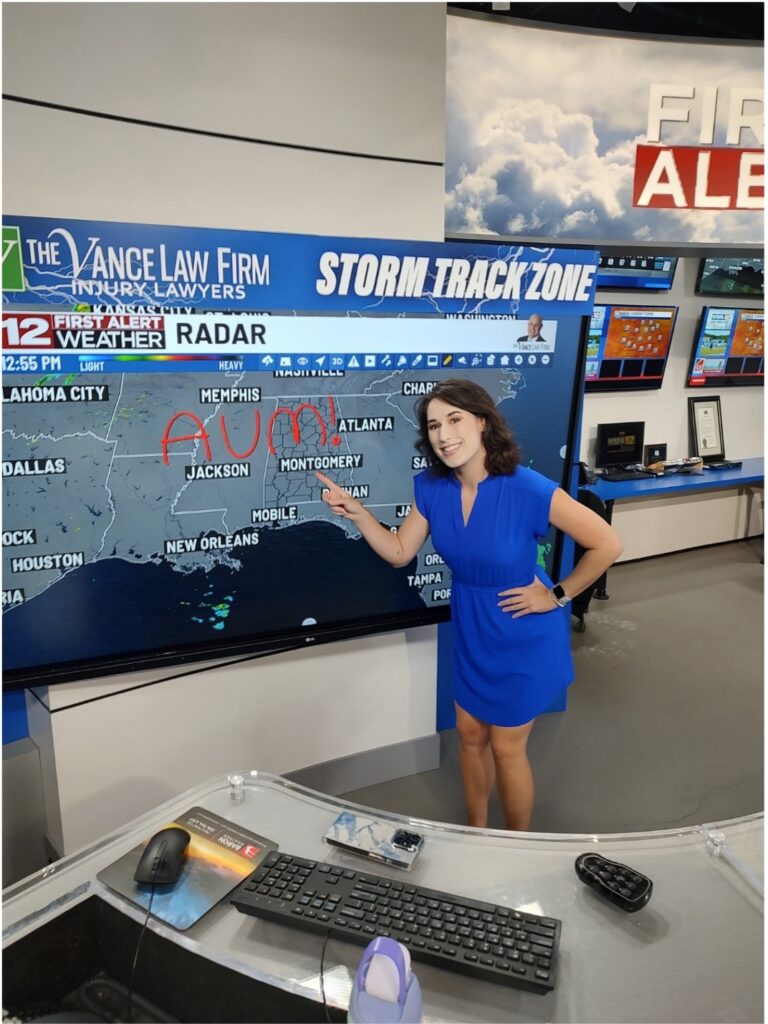
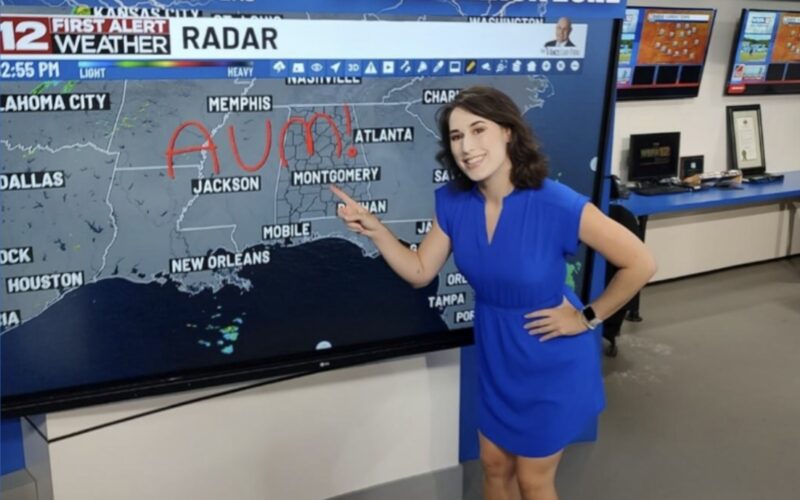
WSFA 12 News Meteorologist Amanda Curran is shown on Sept. 18 in the WSFA 12 television studio in front of the storm track radar screen. Curran, who is from New Hampshire, shares her story on becoming a meteorologist and all the weals and woes that come with it. Photo by Seth Murdick/AUM
In 2017, Curran earned the designation of American Meteorological Society’s Certified Broadcast Meteorologist (CBM), a professional title that signifies a high standard of scientific competence and communication expertise within television and radio broadcast. Along with earning multiple awards, such as the award for ‘Best in Broadcasting’ from the Alabama Broadcaster’s Association, Curran has cemented herself as one of the best meteorologists
Alabama has to offer. Curran specifically credits former WSFA 12 News Director Scott Duff as the one who helped get her where she is. “I cannot emphasize enough how much Scott played a role in it because, unlike a lot of news directors, Scott was the kind of guy who would pour his heart and soul into people,” she said. “He spent two months of going back and forth with me, looking at new demo reels, giving me critiques… I knew that Scott was looking out for my best interest.” She continued, explaining the importance of a support system when making the next big jump in life, “I tell people this all the time… I did the work, but I had somebody supporting me, encouraging me and giving me the resources I need to be able to do that work – somebody told you to go dig a hole and you don’t have any equipment, he was like “Go dig that hole, but let me give you this shovel.”
While good communication skills and colorful dresses are important in her field, Curran wants to make it clear that despite viewers typically seeing her for just a few minutes during newscasts, her work begins far before the cameras roll. “A big misconception about meteorologists is that they get a forecast from somewhere and read off a teleprompter,” she said “everything I say and do is adlibbed… I make the forecasts, I decide what the highs, the lows, what the right chances are going to be; I make those graphics.” She added, “I put all that together and I tell people about it.”
While competent communication on TV remains an important part of being a weather forecaster, not all of it is done within the studio. Curran said she thrives out in the field “I feel that’s where I strive… I’m out in field wearing a big puffy coat and my fingertips are numb.” She later highlighted the fun and significance of being out in the elements “I get to relive my childhood of playing out in the snow while also being able to emphasize the fact that snow impacts people down here a little bit differently and talking about the importance of the safety behind it and explaining to people why it’s happening.”
One aspect that remains consistent for meteorologists such as Curran is the need to understand and work with specialized technologies that allow you to make forecasts. “There’s so many different elements of the forecasts and radar is a big tool that tells us what’s happening in real time here locally in the atmosphere,” she said, “but people forget to look up, there’s satellites that are constantly orbiting our planet… Collecting data, not just here in Alabama but across the region, across the country, across the world because our atmosphere is one big fluid and what’s happening here can influence what’s happening somewhere else,” she added. Despite the array of tools at Curran’s disposal, she admits that nature often puts up a fight that calls for adapting to the situation, “When we’re in Stormtracker, technology doesn’t always work,” she said. “We have this really cool camera on top of Storm tracker and it got glazed over with ice… You have to be really able to be flexible and to adjust, but I would say 99% of the time I have the technology I need at my fingertips,” she added.
The work of a meteorologist and the technology needed for forecasts is extensive and expensive, and with companies spending billions in investments in artificial intelligence to cut corners and costs, according to Blake Montgomery’s August 2025 article in The Guardian. Curran speaks her mind on artificial intelligence’s place in her field. “I think AI weather modeling is something that’s being dabbled in right now that could be beneficial… I think it’s just really important to make sure that you know the source of your weather information.” While artificial intelligence has been used in meteorology since the 1950’s, according to the National Oceanic and Atmospheric Administration, over-reliance on new predictive AI forecasting techniques are still viewed as a potential issue, “With anything new that’s not necessarily tested, vetted for a very long time, there are going to be people who use and abuse artificial intelligence,” she added.
One aspect of meteorologists that AI technology cannot replace is braving tough weather conditions in the name of public service, Curran comments on the comparison made between weather forecasters and first responders. “If I can give you the information that helps you make a critical decision that puts you in a better place than before you had the information, then I did my job right,” she said. “Now, am I running into burning buildings? Absolutely not… Now in a sense I don’t really think that we are first responders because we are usually there before and during an event, we try to be there after too, especially if there’s super impacts and there’s super big cleanup efforts, but I will say that first responders are amazing; we try not to emulate what they do… But if I can give you information that’s gonna empower you, that is my job and my goal every single day,” she added.
According to the Bureau of Labor Statistics, the job outlook for meteorologists shows only a 1% growth with that field from 2024 to 2034. When asked if the meteorological field is a difficult one to break into, perhaps due to being in potentially dangerous situations, Curran had this to say. “There are a lot of people who get into it thinking “I’m gonna be on TV, and that’s cute and that’s fun and I’m gonna make a bunch of money,” she said, “and then they go “wait, this is actually really hard work,” she added. While they may not be racing onto the scene in sirens and flashing lights, meteorologists like Amanda Curran work tirelessly behind the scenes to keep communities safe, often before danger strikes. The next time a severe storm rolls in and alerts light up the screen, remember the team behind those alerts. Long before the rain falls or the winds howl, meteorologists are working overtime with just as much urgency as any first responder.
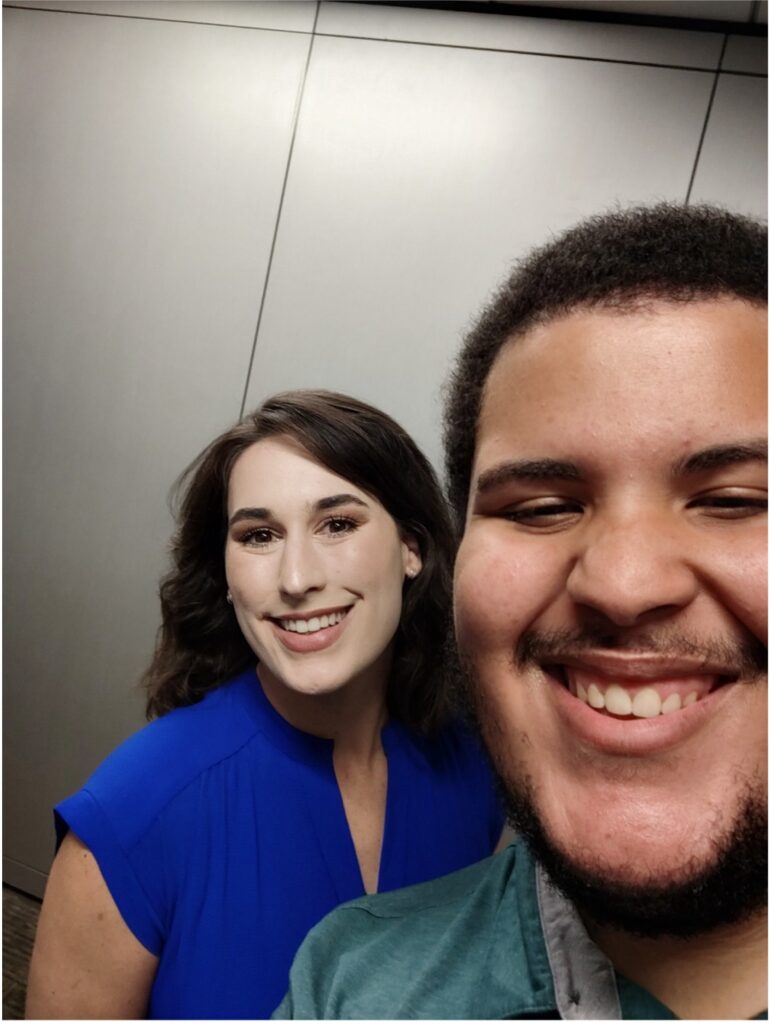
Sophomore Communication major Seth Murdick and WSFA 12 News Meteorologist Amanda Curran are together on Sept. 18 in the WSFA 12 station in Montgomery, Alabama. Murdick, who is from Shreveport, Louisiana and Curran, who is from New Hampshire, discussing the life of a weather forecaster. Photo by Seth Murdick/AUM