

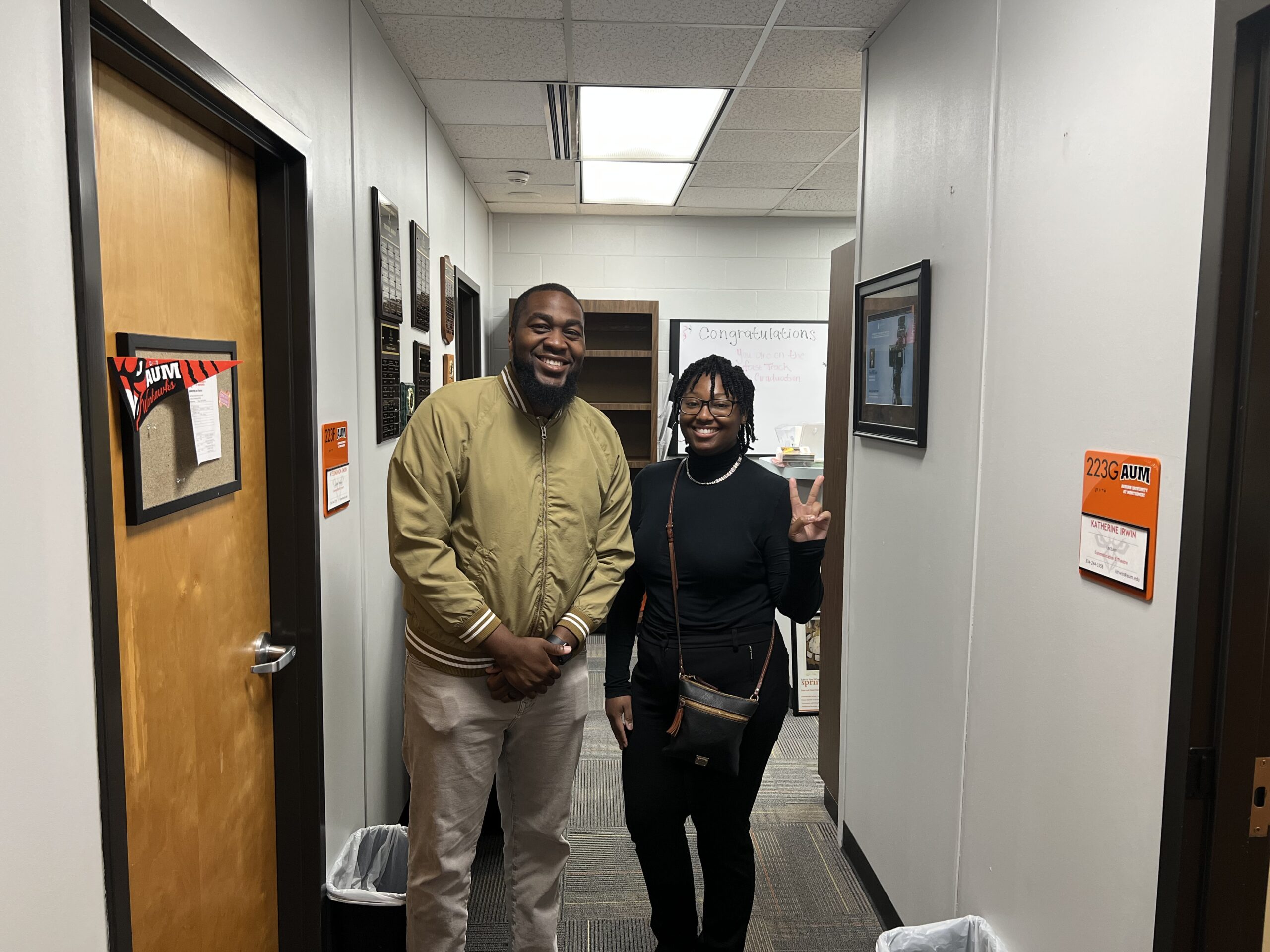
Pastor Chris Searcy poses for a picture with AUM senior Shaniece McGhee after their interview in the Communication Department office on Sept. 22, 2025. (photo courtesy of Nichlos Cutrell)
By: Shaniece McGhee
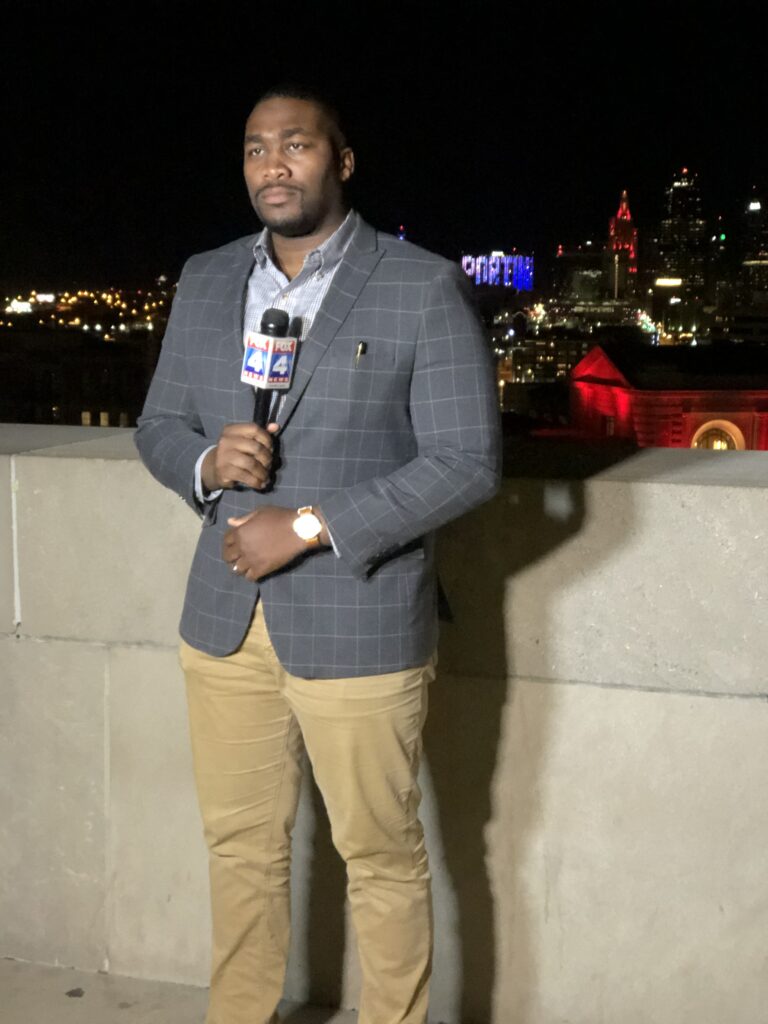
Before Pastor Chris Searcy stepped in front of a newsroom camera, he never imagined his life going that way. His mind was first set on pursuing a career in politics, and he believed that campaigning would be his lifelong career.
But after graduating from Auburn University at Montgomery in 2018, his path shifted. Searcy’s gift for communication opened an unexpected door and shifted his career expectations. Searcy went on to spend years reporting for ABC, CBS and FOX news, which meant he had a front-row seat to history, covering breaking news and community struggles.
“I actually started with a political science degree,” Searcy said. “I had every intention of going into politics. So, I worked on a number of campaigns, my senior year. And being that I had a few communication classes and I participated in some debates, I discovered that I was naturally gifted in communicating.” Soon, he began reporting for ABC, CBS and FOX. He covered breaking news, crime and he found local community stories that helped build faith in the community and also showed the disparity in the community at times.
Reporting Through the Pandemic
Change was inevitable; however, what came next didn’t change just Chris but it transformed the world. According to Pew Research Center writers, Alec Tyson, Michael Lipka and Claudia Deane, in their 2025 report, the pandemic came at a time when the nation was already dealing with political polarization, declining trust in the government, and a flawed system of sharing information. “Being a news reporter during COVID was tough”, Searcy said. Reporting in a time where there was so much confusion and everything around you was turning was a big turning point for Searcy. Especially with being two months on the job, his station goes into full lockdown mode.
“Two months into me being at the station, the station goes into full lockdown mode. I’m working out of my news car, said Searcy. Like many journalists at the time, he balanced daily briefings and the fear that touched many households of the unknown. Although that was the case, the job never ceased. In his honest words, “To sum it up in one word, COVID was nuts.”
The Question of AI

The question of most conversations today is: “Do you consider artificial intelligence to be harmful or helpful?” For AUM senior Jordan White, who studies journalism, this question isn’t a hard one to answer.
“I personally think that AI will create new jobs because I don’t think AI can necessarily do what humans do and consider like more emotional impact when it comes to things like true crime stories or even major big news,” said Jordan White.
A Pew Research Center study that Brian Kennedy and others published on Sept.17 found that 53% of U.S. adults worry AI will harm people’s ability to express themselves artistically. Only 16% believe it will enhance creativity, while another 16% remain indifferent. Meanwhile, a Forbes article by Bernard Marr, written on Aug.18, pointed out that AI is already reshaping industries once thought safe from automation, including software engineering, voice acting and graphic design. Pastor Searcy agrees with the sentiments of the Forbes article.
Learning AI is “one of those things, unfortunately, that you either learn how to utilize it or you’re going to be left behind.” Searcy said. As the CEO of his marketing company that started in 2019.
Searcy has personal experience with using AI to help him with tasks that would normally be tedious; however, he still wants to be as creative as possible with the work he does with his company, so AI is used to a certain extent. “We use AI a ton for the things we’re doing now, such as storyboarding and a little bit of scripting but we try to stay a little bit away from that to be as creative as possible” Pastor Searcy said.
The Choice in between
For Searcy, the hardest part of journalism was dealing with the egotistical side of being a reporter. “If you’re kind of hopped up on the kind of egotistical side of news, like you just want to get the story. You want to do a good job telling the story because you know that’s going to be great for your career.” Searcy said. As a reporter, you have a choice to be on the egotistical side or humble but if you were in a very competitive city, it’s the choice you would have to make” Searcy said.
As for Chris, the job changed how he showed up emotionally. For instance, there was a moment in Chris’s career when he wanted to get a soundbite from a mother whose toddler had just been kidnapped. During the encounter, she was crying uncontrollably; however, Chris had a job to do, so he just wanted her to stop crying so that he could gather the information he needed for the story. Not being in the mindset anymore, he was able to realize that it wasn’t worth it.
“There was no reason for me to be there, you know, pressing somebody whose toddler was just kidnapped for a soundbite. But my job is to get a story!” After reflecting on all of the things he’s done for a story, Searcy realized it didn’t add anything to our collective good.
“When you leave and you step back and you take a look at those scenarios, you’re like man it doesn’t add anything to our collective good”. After becoming successful in his career as a reporter and climbing the ladder, passing others on his way up, reality hit.
“As soon as I pull into the station, I get a call from my wife’s sister and she’s like my wife is going into labor. So, I start freaking out in the car and I calm down and I call my assistant news director to let her know that I have to leave because my wife is in labor. And she says no, we need you to finish your news story because this is the lead story. Searcy said. After realizing that all the sacrifices he has made for his career meant nothing for the job he worked for, the scales fell from his eyes and he was able to see what his life had turned into. “That moment was the moment I was like, I’m done. It was like the chickens coming home to roost; it was then when I saw how unhealthy the environment really was.” Searcy said.
A Turning Point
Trying to find a way to transition out of the news business, another opportunity showed up for the local pastor. A call came from a woman named Nancy from a Kansas City non-profit hospital, Truman Medical Center, who had been told that Searcy would be a good candidate for the marketing manager job. Furthermore, after working for them for a while, he got a call from his parents to consider praying about coming home to help with running operations. Getting that call was definitely a surprise and one where he and his wife weren’t sure about taking their family on that offer being that they loved living in Kansas City. However, many prayers later and one conversation with his mentor changed everything. “For the next six months spend time growing in your faith, get closer to God and if it’s God’s will he’ll move you closer to it; if it’s not in his will, he’ll move you farther away,” Searcy’s mentor said.
During the six months after getting confirmation and a shift in feelings toward the move, a decision in 2024 was made to move back to Montgomery, Alabama, where Chris became the executive director of Fresh Anointing House of Worship. After moving, it wasn’t long before Chris Searcy became Pastor Chris Searcy as he was installed as Senior Pastor of Fresh Anointing in January 2024.
Today, Pastor Chris leads a thriving, family-centered church with a growing college ministry. Searcy focuses on teaching students to live out their faith, all while navigating the pressures of life. With the life lessons Chris has learned it has helped him see life differently than before and now he has a lasting message for anyone who decides to join the media profession.
“Jesus said to the church at Laodicea that they were Lukewarm. You’re neither hot nor cold, so I will spit you out” Pastor Searcy explained. “Back then, people knew lukewarm water was stagnant and full of bacteria and they understood Jesus was saying that they weren’t healing like hot water or refreshing like cold water. They were just contributing to the sickness of society.” As AUM alumni explained this story with seriousness in his voice, he said, “I would encourage people who are taking on the burden or answering the call to be someone who communicates something that you’ll be medicinal, such as helping people heal or be encouraging instead of profiting off of sickness.”