
By: Dezzy Crumpler
MONTGOMERY, Ala. – The week before Carrington Cole was supposed to start working with Marvel Studios in 2020, the world shut down. “The week before I was supposed to start, COVID hit the U.S,” she said. That sudden pause sent her back to Montgomery, where she traded Hollywood dreams for something unexpected: learning to report the news for WAKA in her hometown.
Her journey is more than just a career change; it’s a reflection of the resilience of local journalists who adapt to any challenges thrown at them, large and small. She has faced personal struggles, earned recognition in her community and is now navigating everyday life as a journalist, with the introduction of artificial intelligence reshaping the media industry. At a time when headlines focus on technology and catchy topics, she shows what it means to keep storytelling rooted in people and place.
“This is my home; this is where I’m from,” Cole said. Cole explained that even before college, she had always been drawn to cameras and the art of storytelling. Growing up, her dream was to one day work in Hollywood and bring stories to life on screen. “When I went to Auburn University for college, I got a film degree there and also minored in theater. So that’s how I’m able to kind of perform in front of other people.
When COVID put her film dreams on hold, Cole leaned on a family connection that led her to WAKA. “My dad knew somebody that knew somebody here. I remember I had my first interview with Glenn Halbrooks, who is our news director.” She said, “I just wanted to do camera work and editing, and I remember I was talking to him and he just said, have you ever thought about reporting? You’re very personable and extroverted. And I was like, well, no, I’ve never thought about that… and so he really kind of pushed for that.”
That push shaped the next four years of her career. “On top of all of the many things I do here at the station, I’m a multimedia journalist. I am also a producer. I’m also a photog, which is basically like a cameraman. And I also do editing.” Cole said she always wanted to master every part of the media world. It was an itch she had to scratch. “One of my dreams, and I told a lot of people discussing college, I wanted to learn as much as possible of everything that was in either a TV studio, radio station, film, or even like behind the scenes of a stage play because I always had this idea that if every single person came down with the stomach flu and nobody could come in, I could run the whole thing.”
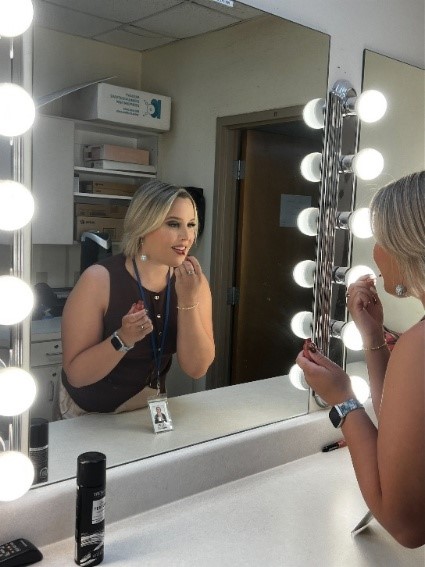
Cole also shared that during college, she took an onstage makeup class at Auburn. She said that experience carried over not only into her career, but also into her everyday life, where she continues to make makeup her own and advises others to do the same.
That versatility is also apparent in her community work. When she first started doing “Pets of the Week” with the Montgomery Humane Society, Cole said her predecessor told her not to do it. That warning only made her want to do it more, and the segment has since become one of her most recognized contributions. She is frequently recognized by it and is highly spoken of amongst the shelter employees; “She lights up a room when she walks in,” many staff members have said.
Despite her drive, she admitted that her career has not been without challenges. “So I actually have really bad anxiety. It’s pretty severe. I go to a therapist once a month and I also take anxiety meds because I get so nervous. That was the first thing when I was on air, I was terrified. I was so scared, which is hilarious, because I love talking.” She laughed. “Yeah, you would never expect that. And I still get very nervous on air. Mostly just because I am talking to a camera and I would rather talk to a person,” emphasizing how human interaction is essential. “But I’ve gotten so much better with it, especially as I have been doing this for so long. I’ve actually been here since May 2021. So about four years. And that’s really just kind of the one thing that still gets me sometimes, but it has definitely gotten better over the years.”
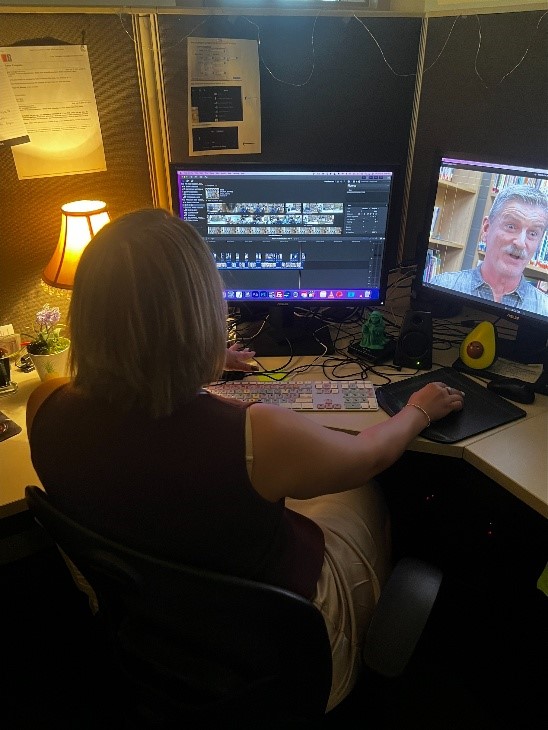
That determination is part of what makes local journalism meaningful to Cole. “The thing I like about local news, especially in the city I grew up in, is I get to tell the story of the people that have been here the same as me, all their lives. And I think that with national news, they want these big, big headlines. With local news, you get to talk to people that never would be able to share their story unless it was from a local news station.”
Cole also stated that with being on air, also comes with recognition “Since I’ve started here, it took about six months before I started getting people to recognize me. And it’s funny now because I get more people that recognize me a lot, especially when I’m dressed up. And it’s mostly people are like, oh, it’s the pet lady, because I do our Pets of the Week segment,” she said. “But I also have people that recognize my voice, which as somebody who has anxiety, I hate my voice. I think it sounds like a weird kindergarten cheerleader. I imagine Bubbles from the PowerPuff Girls as my voice, but most people say they recognize my laugh because I laugh a lot for Pets of the Week, because I’m having fun.”
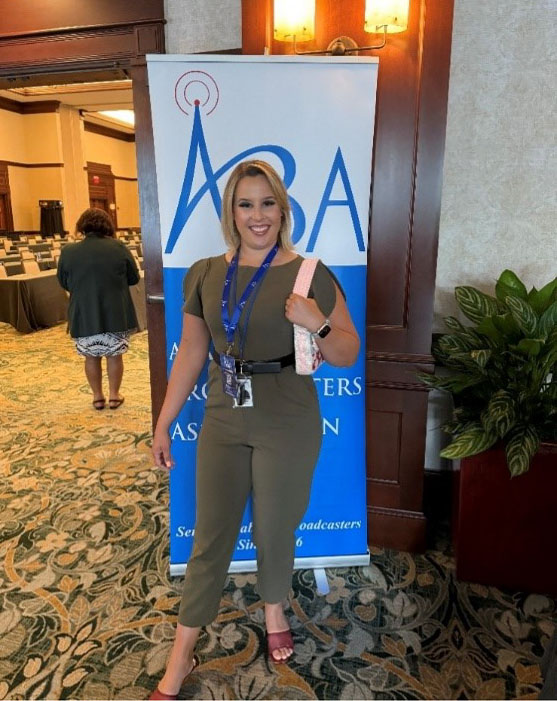
While Cole has been expanding her career, the journalism industry around her has been shifting. She recently attended an Alabama Broadcasters Association conference in Birmingham, where AI in news was a topic. “They had two classes about AI. One was for it, the other was against it. I am kind of in a mixed bag about that because I’m somebody that is always like, I don’t want robots taking over the world, you know? I’ve seen iRobot with Will Smith. We do not want robots taking over the world. But my thing is, I feel like with all technology, it can help you. And it can also hinder you.”
She recalled one example from the conference. “One of the classes, they had an AI person as a news reporter. And the problem with that is AI is not perfect. It cannot think on its own. It has to be told things. It cannot come up with anything new. It only comes up with stuff that’s already been created. And so the news reporter, you could kind of tell that there was something off about her. She was moving her hands too much. Her voice sounded a little garbled, like there was something over the microphone. And then when they said, oh, this is AI, I was like, that makes so much sense.
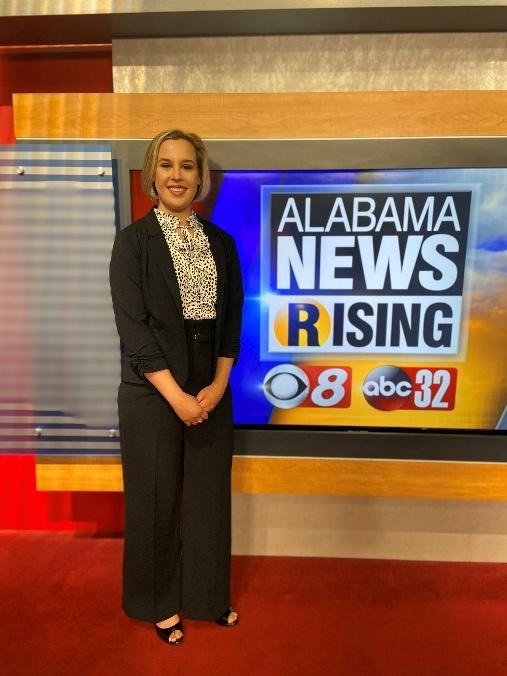
But, she added that AI is also used in smaller and helpful ways, stating that a morning news anchor, Savannah, uses ChatGPT to help her write scripts as she gets up early in the morning, “It’s so hard to think of things on the fly… I’ve seen what it can do. I think we’re going to be okay.”
Cole’s view aligns with what students at Auburn University at Montgomery are already discussing. Kniya Potts, a communication major, said she worries AI will replace entry-level opportunities that help young professionals build experience. “It is replacing routine tasks like writing reports, social media posts or analyzing data, which could make it harder for people to find stable work,” she said. “Even entry-level opportunities might disappear, and AI is being used in hiring too, which can be unfair or biased.”
La’Quita Hugler, a pre-nursing major from Anniston, said she sees both benefits and dangers. “Right now I use it to help with study guides, not to make them,” she said. “I see it as a threat because students are using it for every assignment, and then they are not learning anything. Especially with pre-nursing, if you are becoming a nurse and using AI for everything, you are going to hurt somebody.”
Their perspectives reflect larger debates about AI in Journalism. On Oct. 7 The New York Times Trust Team reported that AI is already assisting with newsroom tasks, such as translation and research, but stresses that human oversight remains essential. In The New Yorker on April 8, 2025, writer Joshua Rotham raised the question of whether AI will save journalism or weaken it by stripping away its human core. Global organizations, including the United Nations Regional Information Centre (2025), have cautioned that although AI may improve efficiency, it also creates risks of deepfakes and misinformation if it is not carefully monitored.
The Centre for Economic Policy Research 2025 research suggested that misinformation can actually push audiences to rely more heavily on trusted outlets, strengthening the role of credible journalism in society. In a May 2025 SAGE Journal article, scholars Tomás Dodds, Rodrigo Zamith and Seth Lewis described this period as journalism’s “AI turn,” a critical moment that requires newsrooms to reconsider both their practices and their ethics. Public opinion also shows caution. A September 2025 Pew Research Center survey found that Americans are more concerned than excited about AI, with many worried that it could weaken essential human skills, even as they acknowledge its value for routine tasks.
For Cole, the larger debated about AI do not erase what matters most to her: Community connection. “That’s what I love about being back in my own hometown is I get to tell people’s stories,” she said. “Sometimes I see people that I used to go to school with or people that I knew from when I was younger. And I’m telling their story. I’m on the news telling their story. And I find that just so amazing that I can come back here and contribute.”
Her advice to students thinking about journalism comes from that same perspective. “Some of the things I can think of for people that are just starting out, whether you want to be a reporter, a photog, just anything in broadcast journalism, just know that you need to put yourself out there. I mean, take it from somebody that has anxiety. Like, nothing can hold you back. If you want it, you can go get it. You need to put yourself out there and almost kind of use your personality as a brand. And so that people can see you and they know you and they’re going to want to watch you.”
Whether she is reporting breaking news, producing segments, introducing the community to adoptable pets or anything in between, the goal is always the same for Cole: to share stories of human interest that matter.