

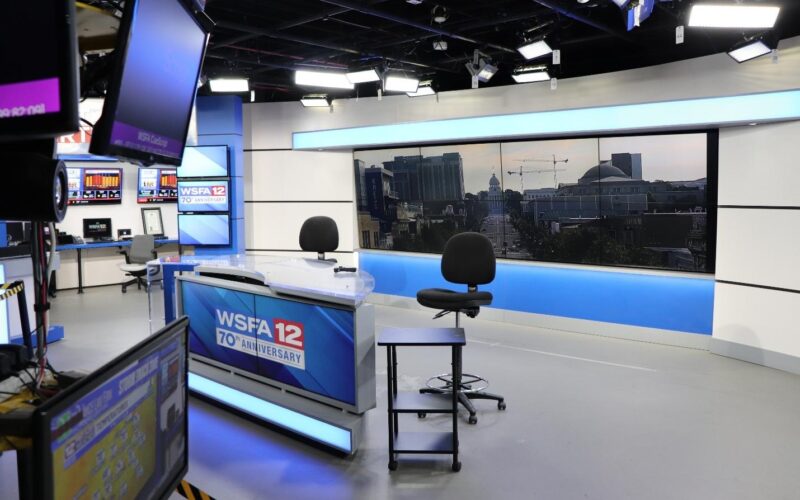
WSFA studio is shown where anchors deliver the news for the people of Montgomery and the surrounding area. (Photo taken by Devin Vaughn)
By: Devin Vaughn
“It’s important to know what draws eyes and ears and what people find appealing.” – Timothy Skipper, WSFA-12
MONTGOMERY, Ala. – “That was a really fulfilling experience,” I thought to myself as I took the elevator down from WSFA’s news floor located in the RSA building downtown. Earlier, I’d had the pleasure of interviewing their marketing producer, Timothy Skipper. His personality came through as we talked about some of his interests, what it’s like working with a news organization, where he wants to go in the future and how artificial intelligence is changing the future.
Our morning began at 8:35 with a ride up to the news studio. I’d noticed that he was wearing black-and-white Nike panda dunks. He had asked if I had ever been to the WSFA studio, to which I replied no. He offered me a tour, allowing me to leave my things in his office, and as we entered, I noticed the Lego plants he had on a desk.
I asked if I could snap a quick picture, to which he responded, “Sure,” and then we went on with the tour.

A picture of Lego cactuses, flowers and a bonsai tree on a desk in Timothy Skipper’s office at WSFA-TV.
He showed me the kitchen where they highlight local chefs every Friday and the WSFA break room that had vending machines in the corner. He even showed me the camera room that had several different lenses, a green screen on the wall and harsh white lights that woke me all the way up. We walked past glass double doors, and he pointed out, “That’s where Gray Media handles all legal aspects regarding the studio.”
Some of the highlights include the main broadcast area that everyone sees on their televisions. “The main reason people watch local news is for the weather,” he said as we came to the Vance Law Firm storm tracker. We also ran into one of the WSFA meteorologists, Nick Gunter, before heading back to his office.
Once we had settled in, he asked if he could look at the questions prepared. I handed him the paper, and he briefly skimmed them before handing it back.
He introduced himself as “Tim Skipper,” a graduate of University of Alabama, sneaking in a “Roll Tide” before mentioning that he’s passionate about “anything creative.” His interests included film, football, good food and “interesting discussions like this one.”
His interest in film prompted me to ask what’s a recent show or movie he enjoyed. He exclaimed that his girlfriend’s favorite show was Game of Thrones, and he had just finished it. Aside from the last season, he thought it was “stellar,” understanding why it was a part of the show people called “peak television.”
Getting back to the focus of the interview, I asked what he went into college doing and how different that was from his current position. Initially, Skipper went into college to be an athletic trainer, thinking that’s what he wanted to do. Despite acing all his classes, he had what he described as an existential crisis over the matter. He had a taste of what that future would entail and realized athletic training wasn’t for him. There was a period of uncertainty, but he knew he was someone motivated by passion, saying, “My love for creativity only grew as I’ve gotten older, and that led me here.”
For Skipper, a lightbulb went off when he saw the movie “La La Land” released in 2016, feeling its tagline, “Here’s to the fools who dream,” was a sign.
He finds what he does to be cool because it allows him to express his creativity in different ways. Skipper told me his work ranges from commercial spots and digital ads to photos and even podcasts. Whether a film or a photo, both require him to work within different criteria, saying that it challenges him and gets the creative juices flowing. This is one of the perks he mentioned he had as a marketing producer.
While he makes content for the news station, he isn’t held to the stricter standards of news professionals. That said, he does view being a part of the station as interesting because he gets to work with different personalities and interact with them for videos and photos.
Some of the banter he has with veteran news anchor Sally Pitts includes him saying “Roll Tide” to which she responds “Stop cursing at me” because she graduated from Auburn University. He also described her as someone who’s funny and kind who will occasionally bring him food.
“Shea Dunaway who works in our sales department is also similar to Sally, but with a thicker southern accent”. Skipper described her as a hustler who excels at her job. Later. he told me that for every louder more expressive employee there is someone who’s on the quieter and reserved side.
I transitioned by mentioning that after sourcing 2022 research done by the Occupational Information Network, DataUSA views social perceptiveness, persuasion, and speaking ability as skills important for a marketing producer to have. Skipper agreed and said speaking might be the most important one and that it’s also important to be knowledgeable about trends. “It’s important to know what draws eyes and ears and what people find appealing.”
I steered the conversation towards discussing AI. It’s becoming a staple for many people across the globe, and discussions about its potential to affect the job market are a concern for some. In a 2023 Forbes article about the future of AI in media and entertainment, Nelson Granados referenced a study done by Pepperdine University professors about the facilitators and inhibitors of AI use. Some facilitators, people who encourage the adoption of AI, note “convenience, customization and efficiency,” while inhibitors slow down the adoption of AI technology use and were identified as “uncertainty, privacy risk and loss of control risk.” Granados added that AI technologies can enhance the creation of content and the media consumption experience. “But because AI adoption requires trust in the machine, the jury is still out as to the extent to which creators and consumers will adopt these technologies,” he said.
Skipper said that his original feelings were pretty vehement towards AI usage, but recently he’s begun using it to help create exercises from “Screenplay: The Foundations of Screenwriting” by Syd Field.
He also acknowledged WSFA’s AI policies, alluding to them being something he has to work within. “Good sound effects can make an ok commercial great. However, after a loss of access to our sound effects library, I’ve had to occasionally use the Adobe Firefly AI to create sounds, like a crowd cheering. They can be hit-or-miss, mostly miss though.”
“We just have to be very careful with how we use it, especially when it comes to the livelihood of other people. It can be a slippery slope.” He said before mentioning there has been entire departments under IBM and Klarna wiped out because of growing AI usage.
Moving away from that, I asked if there were any funny stories he had from working. One of his personal favorites is from a summer fun and food drive in 2023, saying that it was funny and silly and shows a generational divide.
“An older guy came up and asked where Josh Johnson, our chief meteorologist, was at. I said, ‘Oh, he just left, or you just missed him, or something like that.’ Anyways, he told me to tell him, “Just tell us the weather; back in my day we didn’t have all these graphs and colors.”
Skipper laughed, saying that it was just a funny interaction, telling me that “the meteorologists still tell you the weather; it’s just more accurate about where it might rain and how much.”
My second to last question was about what he would tell someone looking to get into his line of work. As a self-described “growth-oriented” person, he referenced “Daring Greatly” by author Brené Brown. Saying that in her book she creates the idea that the little work you complete is better than the big task you don’t do out of fear and uncertainty.
“Early in this role and in my college years, I let the fear of failure and not being good enough become the enemy of good. I think “don’t let perfect be the enemy of good” is good advice just in life in general.”
My last question was one where I wanted to reflect on some of the people he feels helped him get to where he is today.
“My grandmother. She’s one of the most hardworking people I know. My therapist was Susan Mills when I was at Bama. Going to therapy was a hard decision, and she made that process of growth and change really easy. Finally, my chosen family: I’ve had friends whose family would take me under their wing. That could be friends from high school, college or mentors I’ve met over the years.”
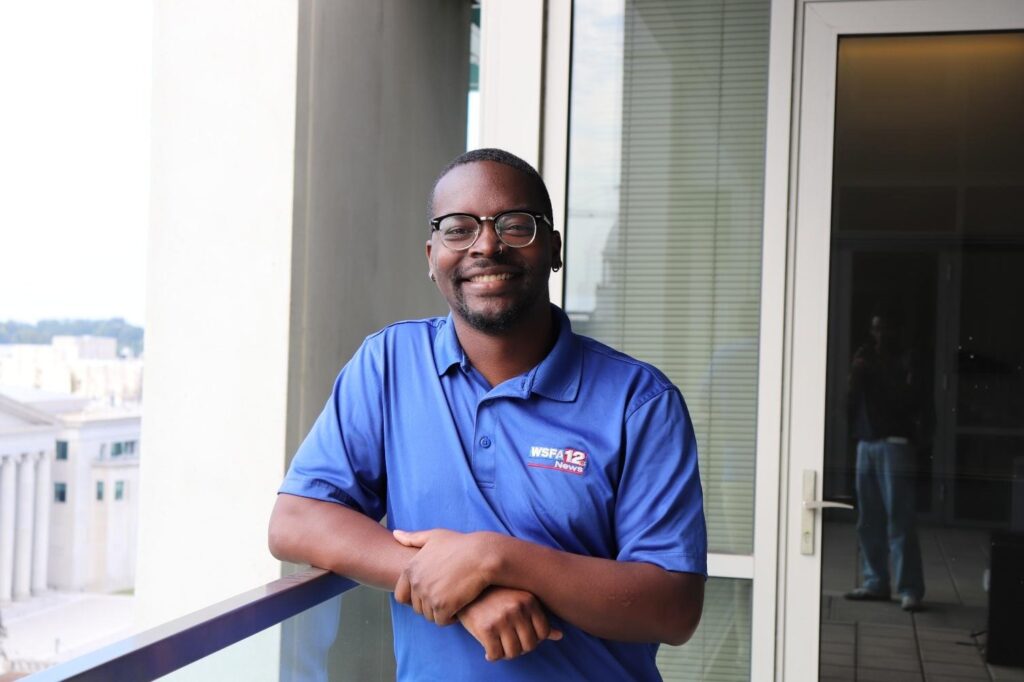
As the interview came to a close, I was able to get a few pictures of Mr. Skipper, and he had the smile of someone who was proud of the person he was becoming. After walking me towards the elevator, he wished me the best of luck on my assignment, and I thanked him graciously for this opportunity.