
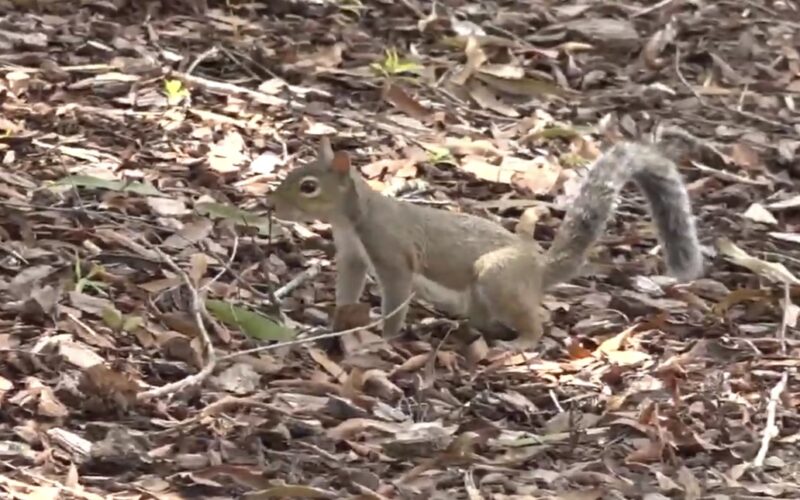
Squirrel rummaging around in leaves on AUM’s campus (photo courtesy of Jordan White).
Squirrels on AUM’s campus are not afraid to throw down a slice of pizza from the Warhawk Cafe or even jump scare students between classes.
“They were jumping out of trash cans since I could remember being on campus,” said Kayla Smith, an AUM alumna.
Data backs up what students notice on campus, as squirrels often thrive in urban settings. According to Fox Squirrel Survival in Urban and Rural Environments, a 2010 article from the Journal of Wildlife Management, studies of rural and urban mammal populations suggest that survival rates may be higher in urban environments.
The article explains that urban squirrels especially benefit from consistent access to food resources like human food waste and direct feeding from humans. It is also highlighted that urban squirrels encounter fewer natural predators in comparison to rural squirrels.
In this 2010 two-year study of fox squirrels, researchers found that during the same 12-month period, urban squirrels had higher survival rates than rural squirrels. Urban fox squirrels not only benefited from a steady food supply but also gained greater security through stable shelter. Whereas rural fox squirrels faced more intense seasonal food shortages and greater threats from natural predators, which lowered their survival chances.
Junior English major Joshua Stout highlighted that the squirrels on AUM’s campus typically like to get up close and personal with people. Many students quickly notice that AUM’s squirrels don’t mind sharing the space with humans. Just on Monday, after the Creative Writing Club met, Stout and his friend, Natalie, witnessed a squirrel grab a slice of pizza and take it up the tree.
Melody Jenkins, a junior psychology student, confirmed seeing the squirrels heavily populated in The Quad and other parts of the campus with trees and bushes. Jenkins recently captured a completely different scene of a squirrel eating pizza in front of Goodwin Hall. She was able to get a close-up video, even though the squirrel kept an eye on her. Jenkins described the squirrel’s expression, “He was just like, you guys don’t normally bother me, so I’m just going to keep on eating.”
Jenkins went on to explain that the squirrels seem to have built their own communities over the years that they have inhabited the campus and become comfortable around people ever since. Her view of campus squirrels as a part of a unified community with students and faculty is both endearing and reflective of how wildlife has adapted to college life. Jenkins went deeper, saying, “They’re close to us because they’re always around us.” She expressed her love for city squirrels’ ruthless nature in comparison to that of rural squirrels.
Over time, the squirrels have become a well-known part of campus life. Smith, who graduated in 2019, highlighted her immediate realization of the squirrels’ unforgettable presence on campus during her first campus visit in 2013.
Smith mentioned that campus squirrels have been causing unexpected scares for students and faculty for as long as she can remember, but they’ve never gone so far as to attack people. When she attended AUM, the squirrels’ Warhawk Cafe food of choice was the chicken tenders.
Whether they’re stealing slices of pizza or startling students on their way to class, AUM’s squirrels have become more than just campus critters. They are a bold reminder of how wildlife adapts, survives and thrives alongside us in even the most unlikely of places.